Journal · Photography
Night Wildlife Photography: How to Shoot Animals After Dark
Night wildlife photography means working with very little light, animals you often cannot see clearly, and subjects that move without warning. It is one of the hardest disciplines in nature photography, and one of the most rewarding, because many animals are most active after dark and are rarely photographed well. Here is how to approach it.

Why photograph wildlife at night?
Many animals do most of their living after sunset. Big cats, hyenas and a whole cast of smaller mammals are often more active in the cool of the night than in the heat of the day. Night images also have a mood daylight cannot give you: dark backgrounds, pools of light, reflections in water and, on the clearest nights, stars overhead.
The big challenge: light
At night your camera is starved of light, and every setting is a trade-off between a sharp, well-exposed image and one that is noisy or blurred. The aim is to gather as much light as you can without letting the animal move out of focus.
Camera settings for night wildlife
- Shoot in RAW. RAW files hold far more detail in the shadows and give you room to correct exposure and colour later.
- Open the aperture. Use your lens’s widest aperture, such as f/2.8 or f/4, to let in as much light as possible.
- Raise the ISO. Modern cameras handle high ISO well. Start around ISO 3200 to 6400 and go higher if you need to. A sharp, slightly noisy image beats a clean, blurred one.
- Keep the shutter fast enough. For a moving animal, aim for 1/250s or faster. For a still animal, you may get away with slower speeds if you are well supported.
- Expose for the subject. Use spot or centre-weighted metering on the lit animal, not the dark background, and watch your histogram.
- Set your white balance. Artificial light is often warm. A custom or fixed white balance keeps colours consistent across a sequence.
Focusing in the dark
Autofocus struggles in low light. Focus on the brightest, most contrasty part of the animal, such as the eyes or the edge of a lit flank. If your camera hunts, switch to manual focus and use a magnified live view or the viewfinder to fine-tune.
Kit that helps
- A fast lens. A lens with a wide maximum aperture, f/2.8 or f/4, makes the biggest difference.
- Solid support. A beanbag or tripod lets you use slower shutter speeds for still subjects. In a hide, a beanbag on the ledge is usually easiest. Our guide to photographing from a hide covers this in more detail.
- A head torch with a dim setting. For finding your settings and kit without lighting up the scene.
- Spare batteries. Long waits, cool nights and live view all drain batteries faster.
Dark subjects need extra care
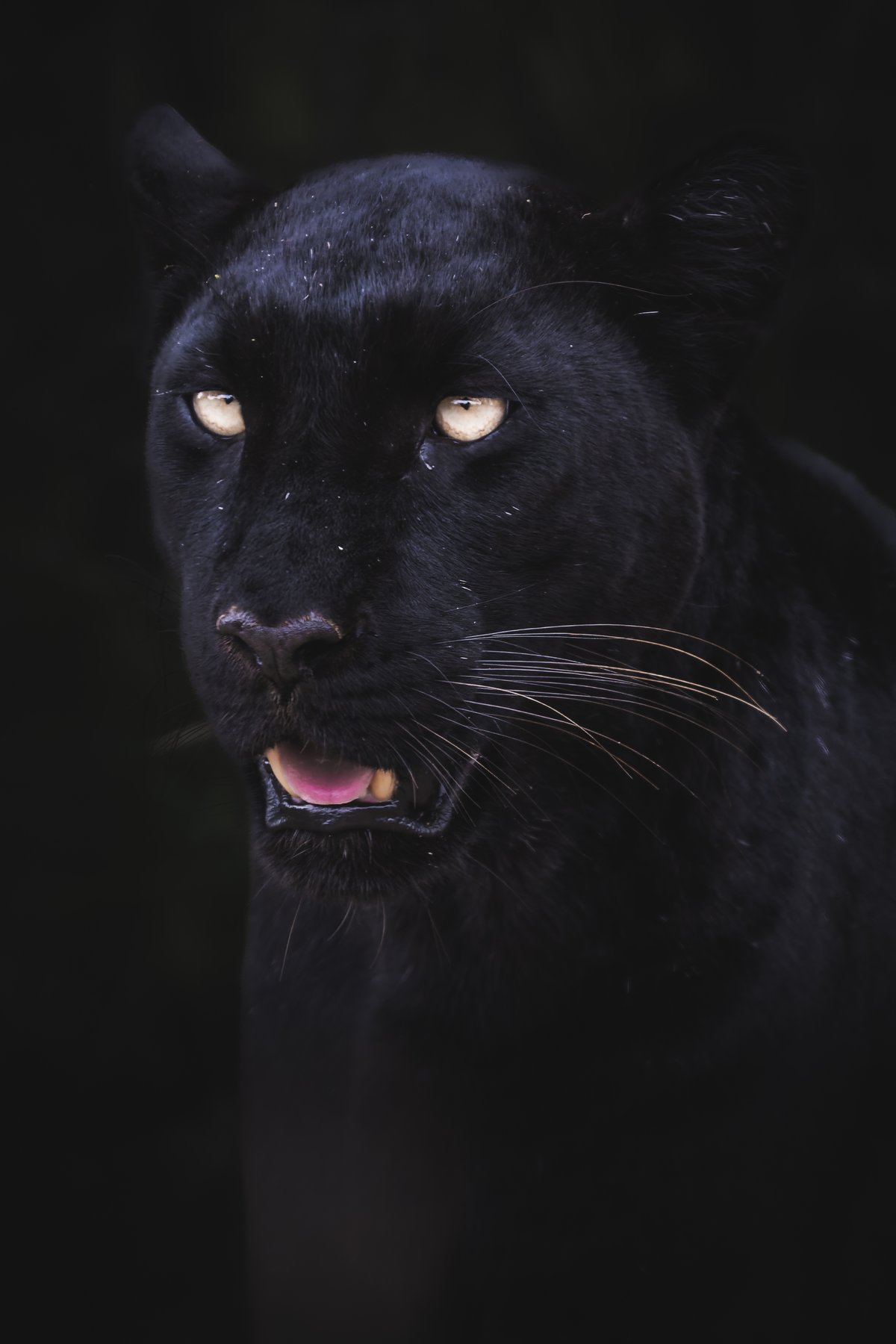
Very dark animals are the hardest of all to expose at night. With a subject like a black leopard, check that the fur still holds detail and that any bright light in the frame is not blown out. Underexposing slightly and lifting the shadows in RAW often works better than overexposing. Read more about these remarkable cats in What Is a Black Leopard?
Wildlife and stars
On clear, moonless nights away from towns, the sky can be dark enough to photograph the stars and even the Milky Way. Combining a landscape or a silhouetted animal with a starry sky usually needs a wide lens, a long exposure on a tripod and a subject that stays still. A common rule of thumb for keeping stars sharp is to divide 500 by your lens’s focal length to get a rough maximum shutter time in seconds.
Night photography ethics
Night is when many animals hunt, feed and rest, and light can disturb them. Good practice is simple:
- Follow your guide on lighting. Use only the lights allowed, and keep them as low and brief as possible.
- Never shine a light into an animal’s eyes or follow a moving animal with a beam.
- No flash unless permitted. Sudden bursts of light can startle animals.
- Never bait or call animals. What you photograph should be natural behaviour.
Night hides at Ewaso
Ewaso Elephant Crossing is a photo hide camp in the Ewaso Enclave Conservancy in Laikipia, with day and night hides. You can read more about our experiences and see photographs from Laikipia in our Gallery.
Questions about night wildlife photography
What ISO should I use for night wildlife photography?
Start around ISO 3200 to 6400 and go higher if needed. Modern cameras handle high ISO well, and a sharp image with some noise is better than a clean but blurred one.
What shutter speed do I need for animals at night?
Aim for 1/250s or faster for moving animals. For a still animal on a steady support, you can sometimes use slower speeds.
What is the best lens for night wildlife photography?
A fast lens with a wide maximum aperture, such as f/2.8 or f/4, gathers the most light and makes the biggest difference at night.
How do you focus on animals in the dark?
Focus on the brightest, highest-contrast part of the animal, such as the eyes. If autofocus hunts, switch to manual focus and use magnified live view.
Is flash photography allowed on night game viewing?
It depends on where you are. Flash can startle animals, so use it only if your guide or camp allows it.
Header photo: Night sky, Laikipia. Photo: Ernesto, 2026.